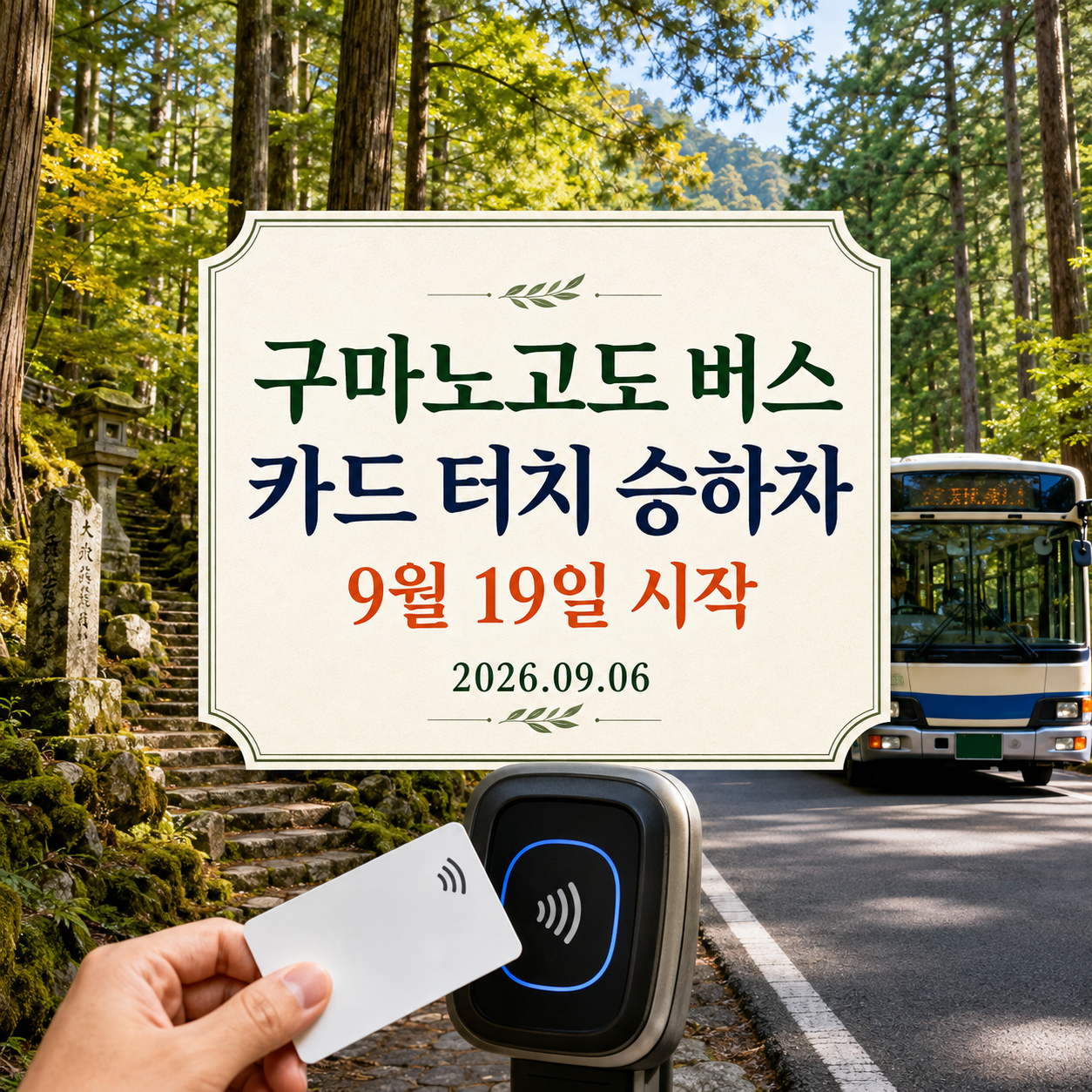
From the first bus on September 19, 2026, the Ryujin Bus Kumano Hongu Line was to accept contactless-enabled credit, debit, or prepaid cards among seven officially supported brands, including Visa, Mastercard, and JCB, or a phone carrying such a card. No ending date was announced. The procedure used the same card/device once at boarding and once at alighting, without installing a separate app or topping up in advance.
JAPAN NOW · KUMANO KODO BUS
Kumano Kodo busesTap a card when boarding and alighting
The introduction covered the Kumano Hongu Line from Kii-Tanabe Station toward Takijiri, Chikatsuyu, Kumano Hongu Taisha, hot-spring villages, and Hosshinmon-oji. Card taps were added to ordinary-fare payments previously described as cash or QR, not a fare discount or conversion into an unlimited pass.
The official announcement offered no contactless-specific discount, daily cap, return discount, or automatic pass conversion. The ordinary fare depended on boarding and alighting points. For several rides, the source advised comparing the total with the separately sold Kumano Hongu Line four-day pass.
What changed?
The joint official release described the previous ordinary-fare methods as cash and QR. Some users needed to prepare cash or set up, top up, and launch an app just before boarding.
Tap a supported contactless credit, debit, or prepaid card, or a phone with that card set up, on the new dedicated reader. The announcement did not abolish existing methods; contactless was an added choice.
The release described a future plan for all Ryujin Bus routes, without timing or an order of rollout. The confirmed September 19 scope was only the Kumano Hongu Line.
Two taps: boarding and alighting
First tap
Place a contactless-marked card or a phone with an enabled card against the new dedicated reader.
Press the stop button
Fares vary with distance. Save the intended stop’s English and Japanese names beforehand.
Second tap
Use the same card or device as at boarding so the system can match the journey.
Check payment history
After registering on the Q-move website, users could view contactless journey records.
Even if the same card is stored in a mobile wallet, the payment system may treat the physical card and phone as different media. Tap the same phone twice or the same physical card twice. The release did not describe settlement after switching media.
Seven supported card brands
Mastercard
Eligible cards were credit, debit, and prepaid products supporting contactless payment.
American Express
Even an overseas-issued JCB card needed contactless support on the actual card.
Discover
A matching brand did not make a magnetic-stripe-only or insert-only card usable.
UnionPay
The seventh supported brand named in the joint announcement.
Conditions for international visitors
Included in the service’s stated purpose
The announcement expressly cited convenience for inbound Kumano Kodo visitors. It stated no nationality, residence, or passport-presentation restriction.
Individual authorization not guaranteed
The seven brands were confirmed, but the release did not establish issuing-country restrictions, approval of every overseas-issued card, or foreign-transaction charges.
Official route information
Ryujin Bus operated an English route/riding-information page. At the September 6 check, the source had not found an official Korean route page.
No advance reservation
Contactless payment was not seat reservation. Because services were infrequent, timetables needed checking separately.
A supported logo is insufficient if contactless is disabled, overseas payments are blocked, or the issuer declines authorization. The announcement gave no compatibility list for individual overseas cards. The source advised checking overseas in-person/contactless settings, with a backup brand and yen cash.
Contactless scope: the Kumano Hongu Line
A Kisei Main Line railway gateway toward Kumano Kodo’s Nakahechi.
A stop serving a principal western Nakahechi trailhead.
Connections to walking starts/finishes including Chikatsuyu village, Nakahechi Museum-mae, and Gyuba-doji-guchi.
Kawayu Onsen
Connections between the Hongu accommodation area and hot-spring villages. Similar stop names made checking the actual lodging stop important.
Use Hongu Taisha-mae; Oyunohara-mae was also included.
A starting point for a popular walk toward Hongu Taisha; some services began at Hongu Taisha-mae.
The officially announced September 19 sections were Kii-Tanabe Station–Hosshinmon-oji and Hongu Taisha-mae–Hosshinmon-oji . Do not extend that claim to pilgrimage buses, Meiko Bus, other Ryujin routes, or other operators toward Kumano Nachi Taisha and Shingu.
Distance-based fares; the four-day pass was a separate purchase
Contactless could reduce change/app preparation for one or two rides. The separate official four-day pass covered unlimited Ryujin Kumano Hongu Line services numbered 80, 81, 84, and 85 for four days from first use. It was not valid on services operated by Meiko Bus.
The release announced no automatic cap or pass conversion. The pass required separate purchase as a web e-ticket or at the Tanabe Tourist Information Center machine in front of Kii-Tanabe Station. The e-pass had to start within thirty days of purchase; the paper pass was valid for four days from purchase.
Some timetable changes also began September 19
Route 81’s W1 service moved ten minutes later from 09:20, arriving Hosshinmon-oji at 09:45.
A daily trial return service ran Kii-Tanabe 06:55 → Hosshinmon-oji 08:54 and Hosshinmon-oji 15:45 → Kii-Tanabe 17:46. No reservation was needed; a separate rapid-service fare table applied.
A once-daily trial ran Yunomine Onsen 09:25 → Hongu Taisha-mae 09:45 → Hosshinmon-oji 10:00, without reservations and using the Kumano Hongu Line fare system.
The rapid bus and Onsen-go began with contactless but were limited trials through December 10, 2026 . For December 11 onward, the source advised using the regular timetable rather than assuming these trial services. Contactless itself had no announced end date.
Before departure
- Check the contactless symbol/settings on the card or issuer app.
- Check overseas in-person payment blocks and limits.
- Use the same physical card or phone on boarding and alighting.
- Carry another international card brand and yen cash with usable change.
- Check the timetable revised from September 19 and the Ryujin operator marking.
- Compare total ordinary fares with the adult JPY 5,000 four-day pass.
- Save screenshots of English stop names such as Takijiri, Chikatsuyu, and the hot-spring villages.
- Recheck official service information and bus positions during heavy rain, typhoons, or road closures.
- Save lodging contacts and an alternative if the last bus is missed.
- QUADRAC: joint Ryujin contactless announcement, September 4, 2026
- Ryujin, Sumitomo Mitsui Card, JCB, Odawara Engineering, and QUADRAC joint release PDF: launch, route, seven brands, and two-tap method
- Sumitomo Mitsui Card official release PDF: stera transit conditions
- Ryujin Bus: official Kumano Hongu Line stops and fare table
- Ryujin Bus: September 19, 2026 revision and trials through December 10
- Ryujin Bus official English: four-day-pass price, route numbers, validity, and payment terms
- QUADRAC Q-move: contactless journey history
EDITOR'S NOTE · EVERYDAY TRIP
EVERYDAY TRIP Editorial Team’s advice
Contactless reduced the need for change; it was not a discount pass. Add fares for all actual sections and compare with the adult JPY 5,000 four-day pass before choosing pay-as-you-go.
Walking speed and weather can alter Kumano Kodo timing. Work from the final return service to choose the ending stop and start time, leaving thirty to sixty minutes of buffer rather than maximizing distance.
The new rapid bus and Onsen-go were trials through December 10, while contactless had no announced end. The original suggested using the trial services in late autumn and replanning with regular services from December 11.
Individual overseas-card approval was not officially guaranteed. Keep different card brands and yen cash separately, and do not switch the card/device between the first and second tap.